
Nixon News & Notes
The redemption of Richard Nixon
In the last five years of his life, when I knew Richard Nixon, nothing described him better than Milton’s “calm of mind, all passion spent.” During the most tumultuous political career in American history he had come back many times, but the greatest comeback of all was in full swing.
His enemies had seized control of the puritanical conscience of America to slay him, unjustly, and he was manipulating the same national conscience, which was founded on Plymouth Rock and has survived all the corruption and hypocrisy and violence of American public life, and when aroused, is insuperable. Since his political fall, and later his death, polls increasingly indicate public unease about the treatment of Richard Nixon. Far from being a singularly morally unsuitable chief of the American state, he is seen as a capable president who was a victim of the nastiest traits and methods of the American jungle that is America’s greatest strength and greatest weakness.
America has tremendous levels of competitiveness and achievement in almost every field, but millions are pitilessly ground to powder. The America of Norman Rockwell and Walt Disney exists, but no one knew better than Nixon, who had climbed all the way up the rickety ladder of American life, that it was a facade.
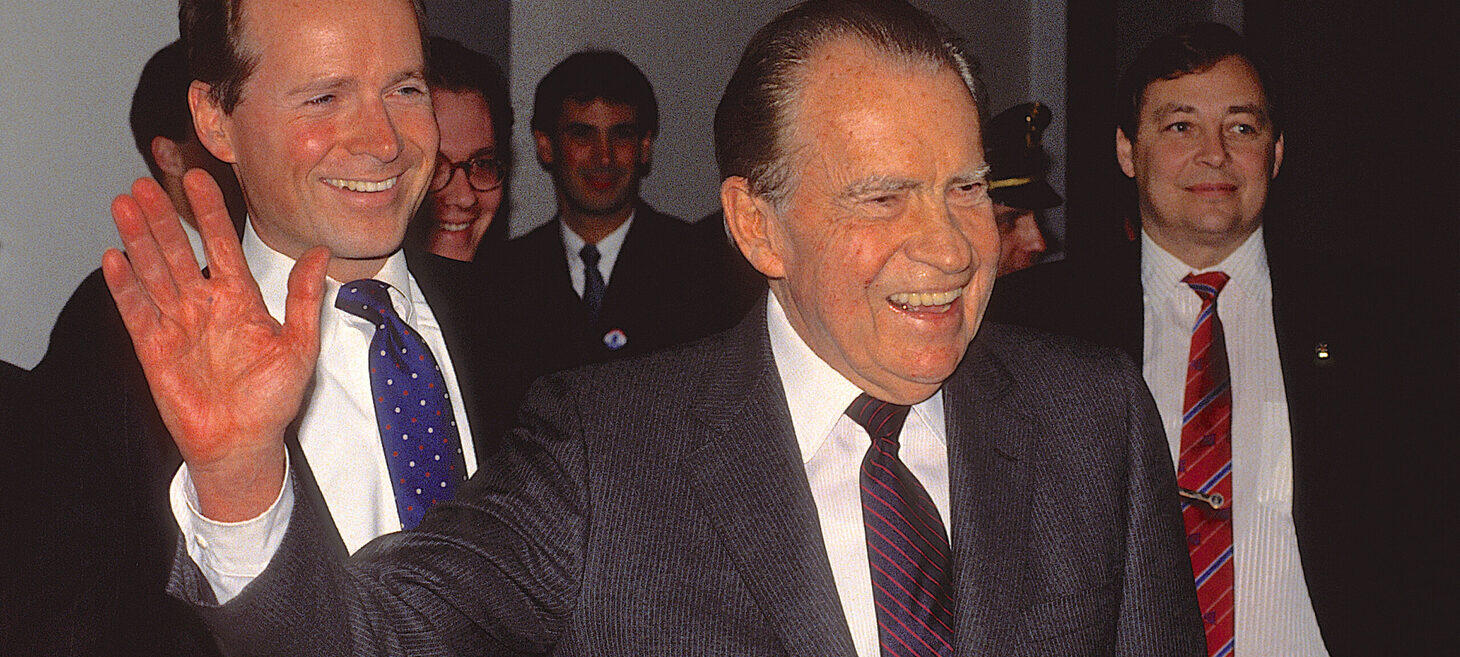
Richard Nixon's elusive totality, with Lee Huebner
In February 1963, Lee Huebner, a first-year graduate student at Harvard University, attended a meeting of a new moderate Republican group called the Ripon Society. Six years later, after having served as the Ripon Society’s national president, he was in the White House as a speechwriter for newly elected President Richard Nixon. Huebner – who was still in his twenties when he joined the new administration – was part of a speechwriting team that included conservatives like Pat Buchanan and William Safire as well as moderates like David Gergen and Ray Price. He stayed in the White House until February 1974, just a few months before Nixon resigned over the Watergate scandal.
During his time in the administration, Huebner saw Nixon up close and came to think of him as having almost a split personality, which White House aides referred to as “the good Nixon” and “the bad Nixon”: “There were two sides to him, two very different sides. And I’m sure he was always puzzled himself by how he would reconcile his more mean-spirited, resentful, defensive personality against his gracious and open and thoughtful and brilliant, far-seeing personality.”
Huebner’s new book, Nixon’s Elusive Totality: It Depends on Who Writes the History, describes Nixon’s conflicting impulses and how they manifested in his speeches and actions. The book also reproduces some of Nixon’s most famous speeches, from his 1952 “Checkers” speech to his final speech to the White House staff as he left the presidency on August 8, 1974.