
Nixon News & Notes
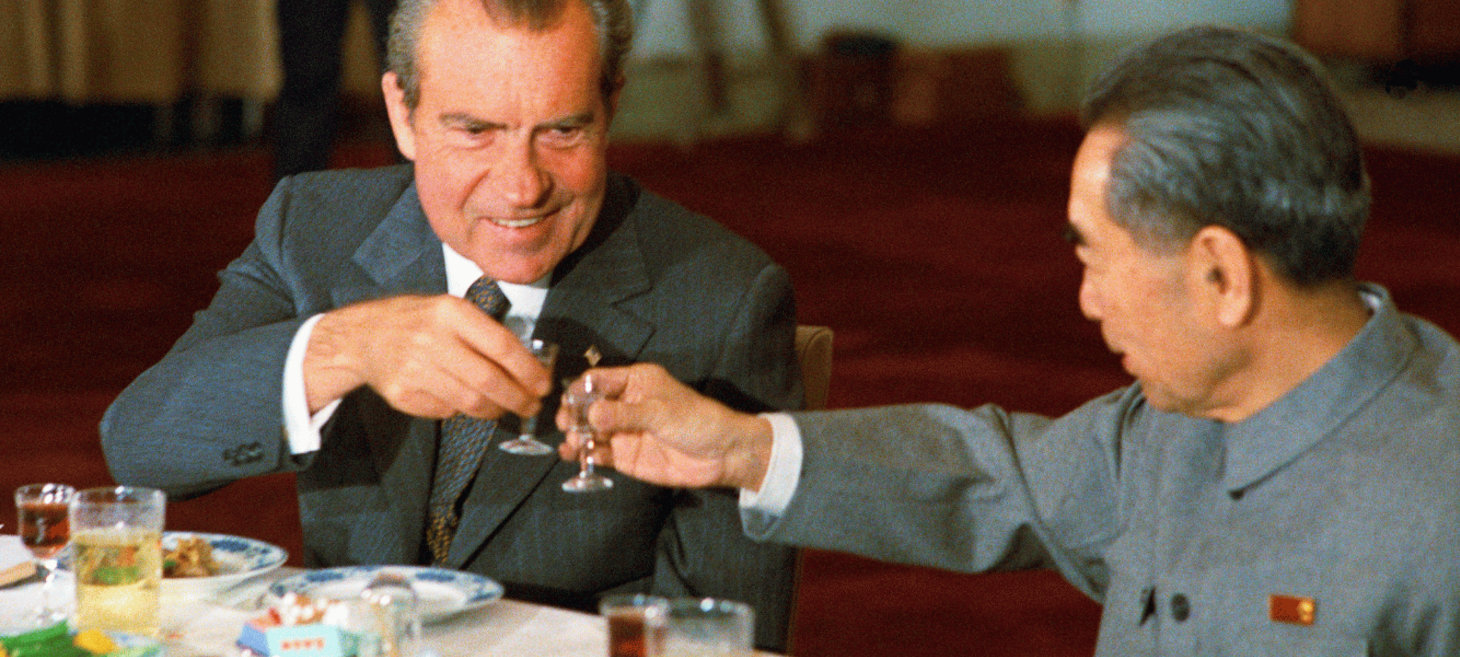
Nixon Was Right
In his history/memoir On China, Henry Kissinger provides a telling anecdote from the period just prior to Nixon’s 1972 rapprochement with Beijing. The US ambassador in Warsaw, Kissinger recalls, had instructions to approach China’s delegation at an event in the capital. When the CCP officials in attendance realised that two Americans were talking and pointing at them from the other side of the room, they left their seats and hurried for the exits. They had received no orders on how to deal with such a situation, and communists do not improvise. The Americans followed, the Chinese quickened their pace, and soon both groups of diplomats were running through the corridors, with the Americans shouting: “We want to meet your ambassador!”
This insistence on engaging the Chinese Communist Party over decades was typical of the United States. The US would try to draw China close, sharing knowledge and assistance, and make a friend of an adversary. There have been times when this approach has looked suicidally naïve, weakening the US while boosting a competitor in a way that never occurred with the Soviets. Huge mistakes were made. Washington was never as tough as it needed to be, and so Beijing grew in boldness and strength until it became difficult and costly for Washington to be tough at all.
Special documents are coming to the Richard Nixon Presidential Library and Museum!
As part of the National Archive “Opening the Vault” initiative, the Richard Nixon Presidential Library in partnership with the Richard Nixon Foundation will showcase seven pivotal documents that have shaped American history.
From September 8, 2026 to October 13, 2026, these artifacts will be featured in the America 250: A More Perfect Union exhibition. The “Opening the Vault” initiative is a series of special exhibits at Presidential Libraries, organized by the National Archives and Records Administration, to honor the 250th anniversary of the United States.
Richard Nixon, the dreamer: The restless road to the 37th presidency
Embarrassing setbacks aside, 1952 turned out to be a good year for Nixon. The Eisenhower-Nixon ticket won the election in a landslide, 442 electoral votes to 89, sending the vice presidential hopeful to the White House just shy of his 40th birthday.
For the next eight years, Vice President Richard Nixon executed his duties well. While the president was recovering from a heart attack in 1955, Nixon used every opportunity to praise Ike and the team he was working with in his absence, and the vice president was commended across the board for his poise. It was a time he described as “drain[ing his] emotional as well as physical energies” but others saw as his “finest official hour.”
He earned clout by confronting Nikita Khrushchev, first secretary of the Soviet Union’s Communist Party, at the 1959 “Kitchen Debate.” When a hostile mob threw rocks at the vice president’s car while he was on a diplomatic mission in Peru in 1958, Nixon ordered Secret Service members to put away their guns so it did not turn into a riot.